Dhikr · Great-Rewards-in-Islam · Jannah wan Naar

Let Jannah and Jahannam make dua to Allaah for you

Anas ibn Malik (may Allah be pleased with him) narrated the Messenger of Allah said: “ Whoever asks Allah for Jannah three times, Paradise says, “ Oh Allah enter him into Jannah. Whoever seeks protection with Allah from Hell three times, Jahanim says, “ Oh Allah protect him from the Fire.”

Collected by At-Tirmithi (2572) and others. Shaykh Al-Albani (May Allah have mercy on him) graded this hadeeth as being Saheeh in Saheeh At-Tirmithi.

Benefits for this subject:

Shaykh Al-Hafith Al-Mubarkfuri ( [1353 H] may Allah have mercy on him) mentioned some valuable information about this hadeeth. He wrote:

“Whoever asks Allah for Jannah…” This can be said with the following words “ Oh Allah, I ask you for Jannah” or “Oh Allah, let me enter Jannah”

“ three times…” This means he repeats that request at one time. Saying it three times is an earnest request. This etiquette of supplication is authentically reported in the Sunnah.

Paradise says, “This is a petition or with it’s tongue. Allah has the ability to make things that don’t normally speak or are non-living talk.

“Oh Allah enter him into Jannah…”Allow him to enter with those in the beginning or with those later.

Whoever seeks protection…”This refers to the person who seeks guard or protection from the Fire.

“ from Hell…”This can be said with the following words, “Oh Allah, protect me from Hell.

“Jahanim says,.. “ This means that Hell says,” Save him and rescue him.”

“ from the Fire…”These words refer to Hell asking Allah to allow the slave to be saved from entering the Fire or residing inside it forever.

Taken from “ Tuhfatul Ahwathee bi Sharhee Jami’ At-Tirmithi”

Dua · Great-Rewards-in-Islam · Jihad

Ask Allah sincerely for martyrdom [Allahumma inni as’aluk ash-shahadah]

“Whoever asks Allah sincerely for martyrdom [Allahumma inni as’aluk ash-shahadah], Allah will cause him to reach the status of the martyrs even if he dies in his bed.” [‘Sahih al-Bukhari’; # 1909]

[Al-`Adawee said it was sound, and that it was reported by by Muslim, page 55 of volume 13; Abu Dãwood, page 179 of volume 2; and Ibn Mãjah, #2797.]

‘And whosoever obeys Allaah and the Messenger then they will be in the company of those that Allaah has favoured: of the Prophets, the Truthful Ones (Siddeeq), the Martyrs and the Righteous – what an excellent company!’ (4:69).

Related Links

Great-Rewards-in-Islam · Qur'an

Surah that protects from the torment of the grave – Surah al-Mulk

Surah that protects from the torment of the grave -  Surah al-Mulk

‘Abdullah bin Mas’ud said: ‘Whoever reads ‘al-Mulk’ (chapter 67 of the Qur`an) every night, Allah will protect him from the torment of the grave. At the time of the Messenger of Allah (peace be upon him), we used to call it al-mani’ah (that which protects). In the Book of Allah, it is a chapter which – whoever recites it every night – has done very well.” [‘Sahih at-Targhib wat-Tarhib’ #1475]

Great-Rewards-in-Islam · Knowledge (ilm)

The Angels lower their wings being pleased with him

inheritance-of-the-prophets

Abu Darda (radiallaahu ‘anhu) narrated that the Messenger of Allaah (salallaahu ‘alayhi wa sallam) said:

Whoever seeks a path to knowledge, Allaah will make easy for him a path to Paradise. Indeed, the angels lower their wings being pleased with the one who seeks knowledge. Whoever is in the heavens and on earth, even the fish in the sea, ask for forgiveness for the scholar. The superiority of the scholar over the worshipper is like that of the moon over all other heavenly bodies. The scholars are the inheritors of the Prophets, for the Prophets did not leave behind Dinars and Dirhams, but they left behind knowledge; and whoever receives it, receives an abundance of good fortune.

(Ahmad, Abu Dawud; authentic)

Related Links :

Great-Rewards-in-Islam · Qur'an · Salah

Death will be the only thing preventing him from entering al-Jannah

The Messenger (sal Allahu alaihi wa sallam) said :

“Whoever recites Ayat Al-Kursiy after each obligatory prayer, then nothing stands in his way to Paradise except death.”

This hadeeth is reported by At-Tabaraani, ibn as-Sunni, ibn Hibbaan, and others. Ibn Hibbaan graded it as saheeh in his book As-Salaat. Al-Haythami said: “At-Tabaraani reported it in Al-Kabeer and Al-Awsat with different narrations, one of them is good.” Al-Haafith ibn Hajar said,“Its isnaad is saheeh…and ibnul Jawzee was inattentive when he reported it in his Mawdoo’aat (fabricated collection of ahaadeeth).” Shaykh al-Albaani authenticated it in As-Silsilah As-Saheehah (vol.2, no.972) and said: “Ibn Khatheer declared it as saheeh in his tafseer (exegesis).” He noted that Shaykh-ul-Islaam ibn Taymeeyah’s calssification of this hadeeth as weak, as in his Fatawaa (22:508), “Appears to be made at the stage when he was beginning to seek knowledge. In fact, his student Imaam ibnul Qayyim related that he (ibn Taymeeyah ) was reported to have said, “I never relinquished [to recite] it after each [obligatory] salaat.” After detailing the various reports regarding this hadeeth, ibnul Qayyim commented, “It has its basis and it is not mawdoo’ (fabricated).” [See ibnul Qayyim’s Zaadul Ma’aad (Beirut, Lebanon: Mu’assasatur-Risaalah (Checked by Shu’ayeb and ‘Abdul Qaadir al-Arna’oot), 2d, ed. 1418/1997)], pp. 293-294.  …from : AayatulQursi – Uthaimeen – From Commentary on Imaam ibn Taymeeyah’s Sharhul ’Aqeedatil-Waasitiyyah

Further Reading :

Great-Rewards-in-Islam · Ramadhan · Salah

Night Prayer in Ramadhan: Get your Past (minor) Sins forgiven

Abu Hurairah (May Allah be pleased with him) reported: The Messenger of Allah (sallallaahu ’alayhi wa sallam) used to urge (the people) to perform (optional Tarawih) prayer at night during the month of Ramadan. He did not order them or make it obligatory on them. He (sallallaahu ’alayhi wa sallam) said,

“Whosoever performs the night prayer in Ramadhaan, with Faith and in the hope of receiving Allah’s reward, will have his past (minor) sins forgiven. ”

[Sahih Muslim]

Further Reading :

Great-Rewards-in-Islam · Ramadhan · Salah

Reward equal to spending the whole night in prayer

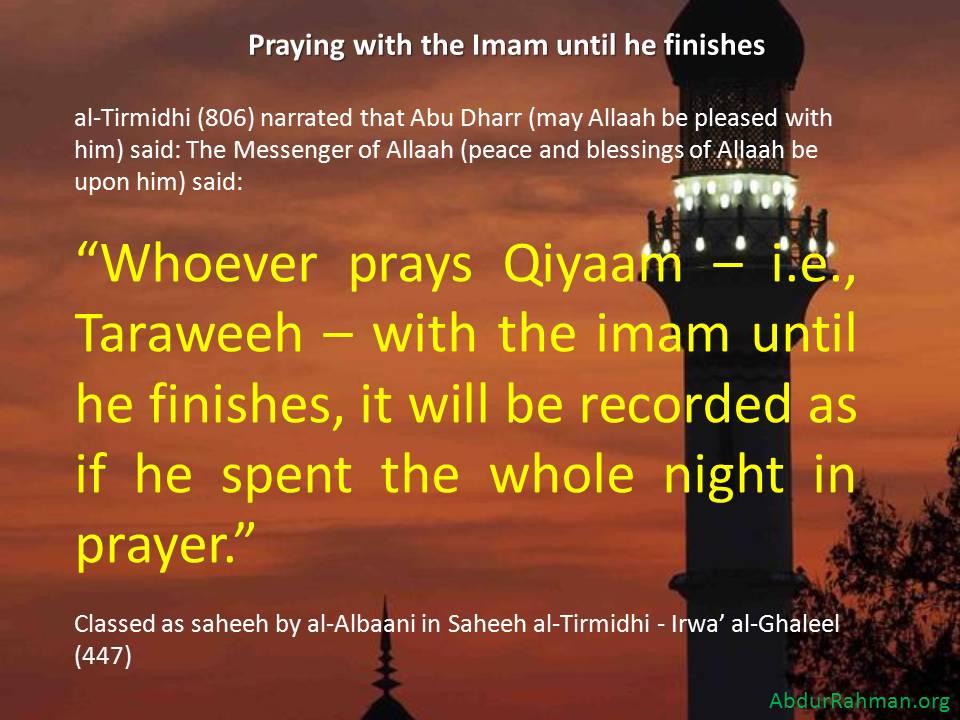
al-Tirmidhi (806) narrated that Abu Dharr (may Allaah be pleased with him) said: The Messenger of Allaah (peace and blessings of Allaah be upon him) said:

“Whoever prays qiyaam – i.e., Taraweeh – with the imam until he finishes, it will be recorded as if he spent the whole
night in prayer.”  

Classed as saheeh by al-Albaani in Saheeh al-Tirmidhi. Irwa’ al-Ghaleel (447)

Shaykh Ibn ‘Uthaymeen (may Allah have mercy upon him) said,

“At first the Prophet (sal Allahu alaihi wa sallam) used to pray Taraweeh in congregation in the mosque, then he stopped because he feared that it might be made obligatory upon his ummah… No man should keep away from Taraweeh prayer lest he misses out on the reward for it. And he should not leave until the imam finishes Taraweeh and Witr, so that he may attain the reward of spending the whole night in prayer.”

Further Reading:

Great-Rewards-in-Islam · Salah

Twenty-Seven times more meritorious

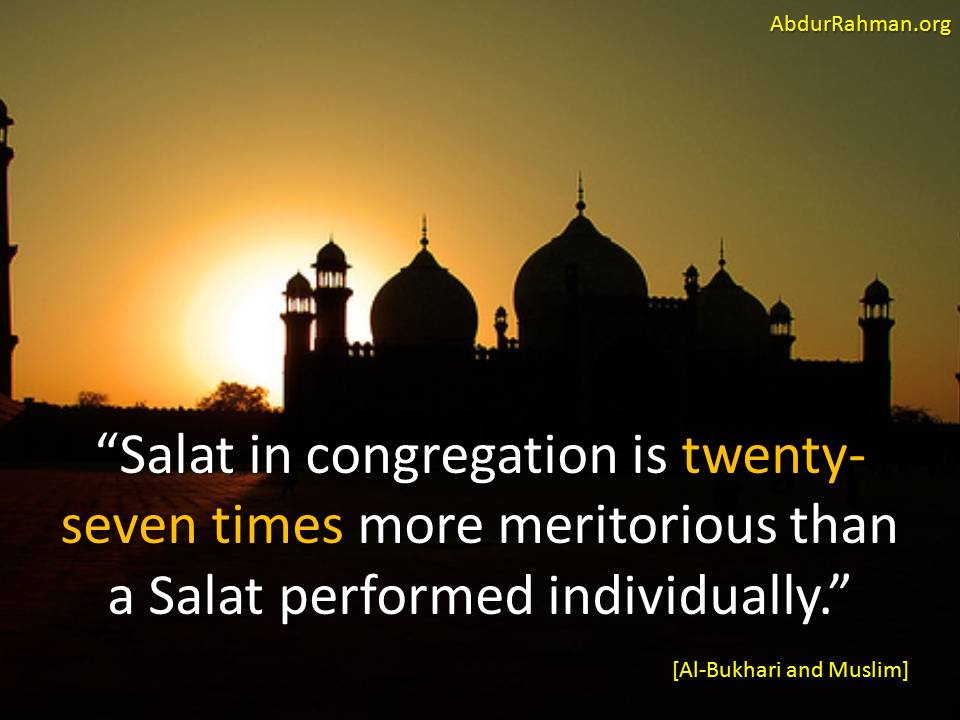
 Ibn `Umar (May Allah be pleased with them) reported: The Messenger of Allah (sallallaahu ’alayhi wa sallam) said, “Salat in congregation is twenty-seven times more meritorious than a Salat performed individually.”
[Al-Bukhari and Muslim].

Further Reading :

Great-Rewards-in-Islam · Salah

Excellence of the Twelve Units of Voluntary Prayers

Umm Habibah (May Allah be pleased with her) the Mother of the Believers reported: I heard the Messenger of Allah (sallallaahu ’alayhi wa sallam) saying, “A house will be built in Jannah for every Muslim who offers twelve Rak`ah of optional Salat other than the obligatory Salat in a day and a night (to seek the Pleasure of Allah).”
[Muslim].

Commentary: Tatawwu` means to offer more Nawafil (optional prayers) on one’s own after performing the Faraid (obligatory prayers). Thus, this Hadith tells us the merits of optional prayers and holds promise of (Jannah) for those who make it a practice.

Further Reading :

Great-Rewards-in-Islam · Ramadhan

Weakness of the Hadeeth: Rewards Are Multiplied 70 Times In Ramadhan

Imaam Ibn Khuzaymah said in his Saheeh:
Chapter: Virtues of the month of Ramadhaan – (only) if the Hadeeth is authentic
`Alee bin Hijr al-Sa`dee narrated to us that Yousuf bin Ziyaad narrated to him that Hammaam bin Yahyaa narrated on the authority of `Alee bin Zaid bin Jad`aan on the authority of Sa`eed bin al-Musayyib on the authority of Salmaan (al-Faarisee) that he said:
The Messenger of Allaah صلى الله عليه وسلم addressed us (i.e. the companions) on the last day of Sha`baan, saying, “Oh people! A great month has come over you; a blessed month; a month in which is a night better than a thousand months; a month in which Allaah has made it compulsory upon you to fast (by day), and voluntary to pray by night. Whoever draws nearer (to Allaah) by performing any of the (optional) good deeds in (this month) shall receive the same reward as performing an obligatory deed at any other time, and whoever discharges an obligatory deed in (this month) shall receive the reward of performing seventy obligations at any other time. It is the month of patience, and the reward of patience is Paradise. It is the month of charity, and a month in which a believer’s sustenance is increased. Whoever gives food to a fasting person to break his fast shall have his sins forgiven, and he will be saved from the Fire of Hell, and he shall have the same reward as the fasting person, without his reward being diminished at all”. They said: “Not all of us can find that which (we can provide to) the fasting person to break his fast.” He said: “Allaah تعالى gives this reward to anyone who helps the fasting person in breaking the fast even by a (single) date or provides him with water to drink or gives him milk. And it is a month the beginning of which is Mercy, its middle is Forgiveness, and its last is emancipation from the Fire.  Whoever reduces (the burden) on his slave, Allaah will forgive him and will emancipate him from the Fire. And increase in it the four things: Your Lord is pleased with two things, and with the (other) two He will enrich you. The two things with which your Lord is pleased are bearing witness that Laa ilaaha illallaah (there is no one worthy of being worshipped except Allaah) and that you seek His forgiveness. And the two things with which he will enrich you are when you ask for Paradise from Allaah and that you seek His refuge from the Hell. And whoever feeds a fasting person till he is satisfied, Allaah will give him the drink from my Cistern, the drink after which he will not feel thirsty till he enters the Paradise.” [Saheeh Ibn Khuzaimah (1887)]

The verdict of the scholars about the weakness of this Hadeeth:
Al-`Ainee said in “`Umdahtul-Qaaree”: The chain is not authentic.
Dhiyaa al-Maqdasee said in “al-Sunan wal-Ahkaam”: in its chain there is `Alee bin Zaid bin Jad`aan and a group of scholars spoke about him.
Ibn Hajar also graded it “Weak” in “al-Talkhees al-Habeer”.
Al-Mundhiree in “al-Targheeb wal-Tarheeb” affirmed its weakness.
Al-Albaanee graded it “Very Weak” in al-Mishkaat al-Masaabih (1906).
And he graded it “Munkar” (rejected) in al-Dha`eefah (871), and also in Dha`eef al-Targheeb (589).
Shaikh al-Albaanee comments about this Hadeeth:
(After mentioning the above Hadeeth he (Al-Albaanee) said): “Munkar” (Rejected).
It was reported by al-Muhaamalee in “al-Amaalee” (Vol. 5 No. 50); and by Ibn Khuzaimah in his “Saheeh” (1887) and he (Ibn Khuzaimah) said: “If it is authentic”; and by al-Waahidee in “al-Waseett” (1 / 640 / 1-2).
The narration of it is based on the authority of `Alee bin Zaid bin Jad`aan on the authority of Sa`eed bin al-Musayyib from Salman al-Faarisee that he said: The Messenger of Allaah صلى الله عليه وسلم addressed us on the last day of Sha`baan and he narrated the Hadeeth.
I (Al-Albaanee) say: “This chain of narration is weak because of `Alee bin Zaid bin Jad`aan, for he is weak as what (Imaam) Ahmad and others have said about him.
And Imaam Ibn Khuzaimah said the reason is: “He is not someone to be taken from because of his weak memory.”
And that is why when he (Ibn Khuzaimah) mentioned this Hadeeth in his “Saheeh” he pointed out (itsweakness) by saying: “(only) if the Hadeeth is authentic.”
And al-Mundhiree affirmed it in “al-Targhheb” (2/67) and said: “Al-Baihaqee reported with his chain of narration.””
I (al-Albaanee) say: The reason why Ibn Khuzaimah reported the likes of this Hadeeth in his “Saheeh” is to strongly point out that what is mentioned in it is not authentic according to him and to warn (the people about its weakness).
But some of the authors of “نصرة الخلفاء الراشدين والصحابة” were ignorant about this reality. They mention on the cover of their book: “The Hadeeth (of this book) were verified by the `Alim, the Faadhil, the custodian of the Hadeeth…”, but they say on page 34: “It was reported by Ibn Khuzaimah in his “Saheeh” and he authenticated it.”
They say it (in such a way) as if they did not know what Ibn Khuzaimah had said about the Hadeeth. But if they did know it, then they have openly lied upon Ibn Khuzaimah. And this is not strange from them, because as has preceded from them, their messages are full of slanders and lies without bounds. And it is not advisable to waste time on replying to them, because they do not take advice.
And about this Hadeeth, Ibn Abi Haatim reported from his father in “al-`ilal” (1/249) that it is “Munkar”.

“Whoever draws near to Allaah during it (Ramadaan) with a single characteristic from the characteristics of (voluntary) goodness, he is like whoever performs an obligatory act in other times. And whoever performs an obligatory act during it, he is like whoever performed seventy obligatory acts in other times.” – Sahih Ibn Khuzaymah, no. 1887.

Further Reading :